
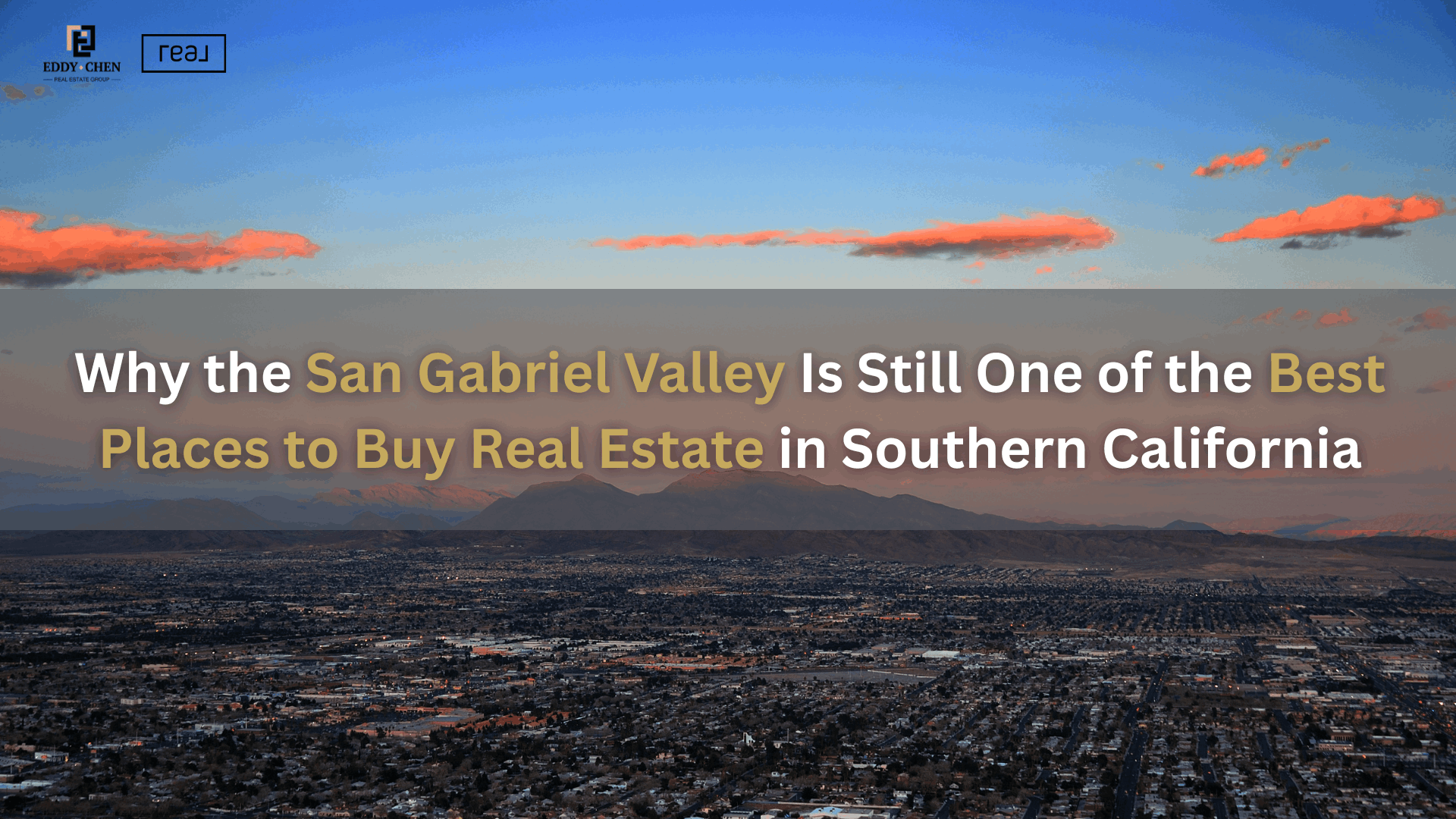
Why the San Gabriel Valley Is Still One of the Best Places to Buy Real Estate in Southern California
The Market That Quietly Outperforms
If you follow Southern California real estate headlines, most of the attention goes to the Westside — Beverly Hills, Brentwood, Santa Monica, Malibu. Those markets are real, and they're genuinely prestigious. But they're not where most of the wealth in Southern California real estate has quietly been built over the past thirty years.
That's been happening in the San Gabriel Valley.
I've been working in this market since 2004. I've watched cities like Arcadia, San Marino, Temple City, and Walnut go from being described as "affordable alternatives to the Westside" to standing on their own merits as premier residential addresses. The appreciation has been significant. The fundamentals that drove it haven't changed. And unlike a lot of markets that got overextended during the pandemic boom, the SGV's underlying demand drivers are structural — they don't go away when interest rates move.
Here is why the San Gabriel Valley continues to earn its place among the best real estate markets in Southern California.
The School Districts That Drive and Sustain Demand
No single factor has been more responsible for the SGV's sustained real estate demand than its school districts. And no single factor is more likely to continue supporting values over the long term.
Arcadia Unified, San Marino Unified, and Temple City Unified are among the top-performing public school districts in Los Angeles County. Walnut Valley Unified — serving Walnut and Diamond Bar — has a similarly strong reputation, particularly for math and science programming. These aren't just marketing claims. The CAASPP scores, graduation rates, AP pass rates, and college placement outcomes are documented and consistent year over year.
For buyers from any background — and particularly for the large Chinese-American community that has long valued educational achievement — these school districts represent something money cannot easily replicate elsewhere in the region: access to top-tier public education at the price of a market-rate home.
The practical effect on real estate is straightforward. As long as these school districts maintain their performance, families will compete to buy within their boundaries. That competition creates a floor under prices that persists through market cycles in ways that purely location-driven markets don't always sustain.
Value Relative to Comparable LA Markets
The comparison that surprises buyers who haven't looked at the SGV carefully: what does a given dollar buy here versus elsewhere in Southern California?
A $1.5 million budget in Arcadia gets you a 4-bedroom single-family home in good condition in one of LA County's top school districts, with a real yard, and a commute to downtown LA of 30–40 minutes.
The same $1.5 million on the Westside gets you a 2-bedroom condominium, or a small single-family home that likely needs significant work, in a school district that — despite the zip code premium — may not outperform Arcadia Unified on actual academic metrics.
This is not a criticism of the Westside. The lifestyle proposition there is different, and proximity to the coast and certain employers has real value. But for buyers who are prioritizing schools, space, and long-term appreciation — and who are not anchored to a Westside employer or lifestyle preference — the SGV offers a genuinely superior value proposition at most price points.
The Diversity of What's Available
One of the SGV's underappreciated strengths is the range of housing types, price points, and lifestyles it contains within a relatively compact geographic area.
A buyer with a $650,000 budget and a first-time buyer loan can find a viable condo or townhome in Alhambra or Monterey Park with access to good schools and freeway corridors. A buyer with a $3.5 million budget can purchase a substantial estate in San Marino or upper Arcadia with a large lot, architectural character, and an elite school district assignment. And at every price point between those extremes, there are real options in cities with distinct characters — the suburban spaciousness of Walnut, the established charm of Pasadena, the accessibility of Temple City, the investment potential of San Gabriel.
This internal diversity means the SGV can serve a wide range of buyer needs and still function as a cohesive market. Buyers who start in one part of the SGV and move up over time — from a Monterey Park condo to an Arcadia single-family home to a San Marino estate — can do so within the same geographic footprint, maintaining community connections and school district access along the way.
The International Buyer Base Creates Market Liquidity
A feature of the SGV market that domestic buyers sometimes underestimate is the effect of the international buyer base on market liquidity.
Cities like Arcadia, San Marino, San Gabriel, and Rowland Heights have significant populations of buyers with ties to Mainland China, Taiwan, and Hong Kong. This buyer segment is often well-capitalized — purchasing with cash or large down payments — and highly motivated by the school districts and community infrastructure the SGV offers.
The practical effect for sellers and long-term owners: the SGV has a broader and more geographically diverse buyer pool than most SoCal markets. When domestic buyer activity slows — as it did during the 2022–2023 rate adjustment period — the international buyer segment continued to transact. This depth of demand is a genuine market stabilizer that has historically prevented the kind of sharp corrections that hit more rate-sensitive markets harder.
For investors and long-term owners, a liquid buyer pool is not an abstract benefit. It means you have exit options when you need them.
Long-Run Appreciation: What the Data Shows
The numbers speak clearly. SGV residential real estate has appreciated significantly over every extended holding period I've observed in this market.
Long-time homeowners in Arcadia who purchased in the early 2000s have seen their properties appreciate by multiples of their original purchase price. San Marino properties that were considered expensive at $800,000 in 2005 have transacted well above $2.5 million in recent years. Even in cities like Temple City and Monterey Park — which were considered starter markets twenty years ago — values have grown substantially.
The structural reasons for this appreciation aren't going away. Geographic constraints on new supply, persistent in-migration demand from domestic and international buyers, top-performing school districts, and proximity to major LA employment centers all continue to support values.
This doesn't mean the SGV is immune to cyclical corrections — no market is. But the floor under SGV values has historically been higher than in markets without these structural supports, and the recovery from any downturn has been faster.
What Different Buyer Profiles Find in the SGV
Families with school-age children find in the SGV what they can't easily find elsewhere in LA County: top-tier public schools at market-rate prices rather than private school tuition or Westside premiums. For this buyer profile, the SGV often offers the highest total value proposition in Southern California.
Investors find in the SGV a market with real rental demand, ADU development opportunity, and long-run appreciation that consistently rewards patient capital. The cash flow profile is thin at current prices and rates, but the total return picture over 7–10+ year holds has been strong.
Chinese-speaking and international buyers find in the SGV a community infrastructure — language, food, banking, schools, social networks — that doesn't exist at the same depth anywhere else in the Los Angeles region. This isn't incidental. It's one of the primary reasons the SGV commands the premium it does relative to otherwise comparable markets.
Move-up buyers from other parts of LA find in the SGV the space, the schools, and the community character that the neighborhoods they're leaving behind can't offer at their budget level. The trade of a smaller Westside home for a larger SGV home with a better school district is one I've helped many families make — and most of them look back on it as one of the best financial and lifestyle decisions they ever made.
FAQ
Is the San Gabriel Valley a good place to invest in real estate?
For long-term investors, yes. The SGV has shown strong appreciation, consistent rental demand, and ADU development potential that improves income returns. It's an appreciation-forward market rather than a cash-flow-first market — investors who understand this and hold for the long term have historically done well.
Which SGV city has the best schools?
San Marino Unified is consistently ranked at or near the top of LA County public districts by test scores and college placement. Arcadia Unified and Walnut Valley Unified are close behind and offer more housing inventory at more accessible price points.
How does the SGV compare to other LA neighborhoods for appreciation?
SGV appreciation has been competitive with or superior to most non-coastal LA County markets over 10- and 20-year periods. The structural demand drivers — schools, community, geographic scarcity — have supported values through multiple market cycles.
What price ranges are available in the SGV?
The SGV covers a wide range. Entry-level condos in Alhambra and Monterey Park start around $550,000–$700,000. Single-family homes in core SGV cities range from the mid-$800,000s in accessible cities to $3.5 million+ in San Marino. The full range is broader than most buyers initially expect.
Is it hard to buy in the SGV as a first-time buyer?
It's competitive in the entry-level ranges, but first-time buyers with solid financing and the right agent guidance do close deals in the SGV regularly. Cities like Alhambra, Monterey Park, Temple City, and San Gabriel offer genuine entry-level opportunities with real upside.
If you're considering buying, selling, or investing in the San Gabriel Valley — whether you're a longtime SGV resident or exploring the market for the first time — I'm happy to walk you through what the current market looks like and what your realistic options are.
Categories
Recent Posts